Early physics based concept
designs.
New game ideas, built far enough to play and judge. Unfinished on purpose, so they are cheap to change or bin.
Ricochet.
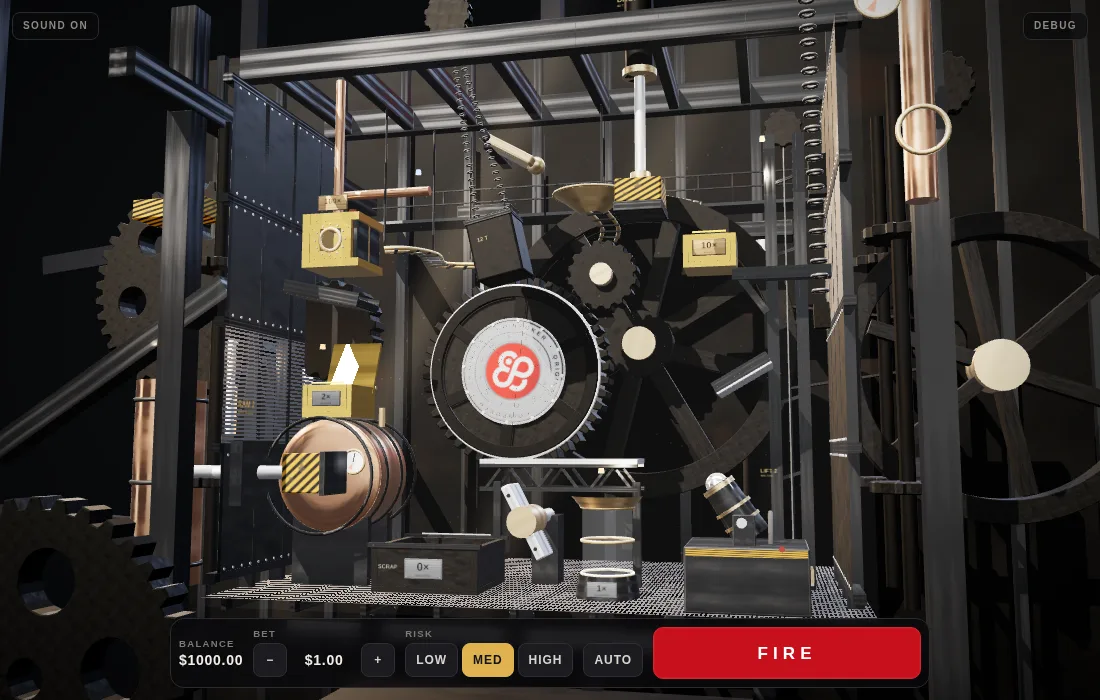
One button, one steel ball, and a machine.
 Play it here
Space to fire · drag to look around · D for debug
Play it here
Space to fire · drag to look around · D for debug
You press FIRE. A heavy chrome ball gets launched into one section of an enormous working machine. Gears flick it, a hammer flattens it, a lift catches it and fires it back across. Two to four seconds later it lands in a multiplier.
The result is picked before the ball moves. The machine then plays a real physics route that ends in that exact spot, so it's showing you the answer the long way round. Ready for provably fair seeds when CoinPoker wants them.
- 100×Trips a lever, rides a rail behind the flywheel and opens the vault. The camera leans in. Rare.
- 10×The high hatch. Every route there goes under the drop hammer first.
- 2×The boiler hatch. Usually off the great gear, sometimes after a ride up the lift.
- 1×The glass tube at the bottom. Money back.
- 0×The scrap hopper. The house thanks you.
Why I don't think it's worth developing.
I've spent a fair bit of time on this one and I'm glad I built it, but I don't think it should go any further as a game. Three reasons.
You press one button and watch. There's no decision to make, so when it lands in the 10× it doesn't feel like you did anything. The win just happens to you, and I think that takes most of the buzz out of it.
The first ten shots are great. By about the thirtieth you've seen most of the routes, and you're waiting three seconds for a result Limbo or Dice would give you instantly.
It feels more like a tech demo or a screensaver than something people would sit and play for an hour. Nice to look at, but I can't see it holding anyone.
Launch Test.
A car, a wall, and one very brave dummy.
 Play it here
Space or CRASH to play · D for debug
Play it here
Space or CRASH to play · D for debug
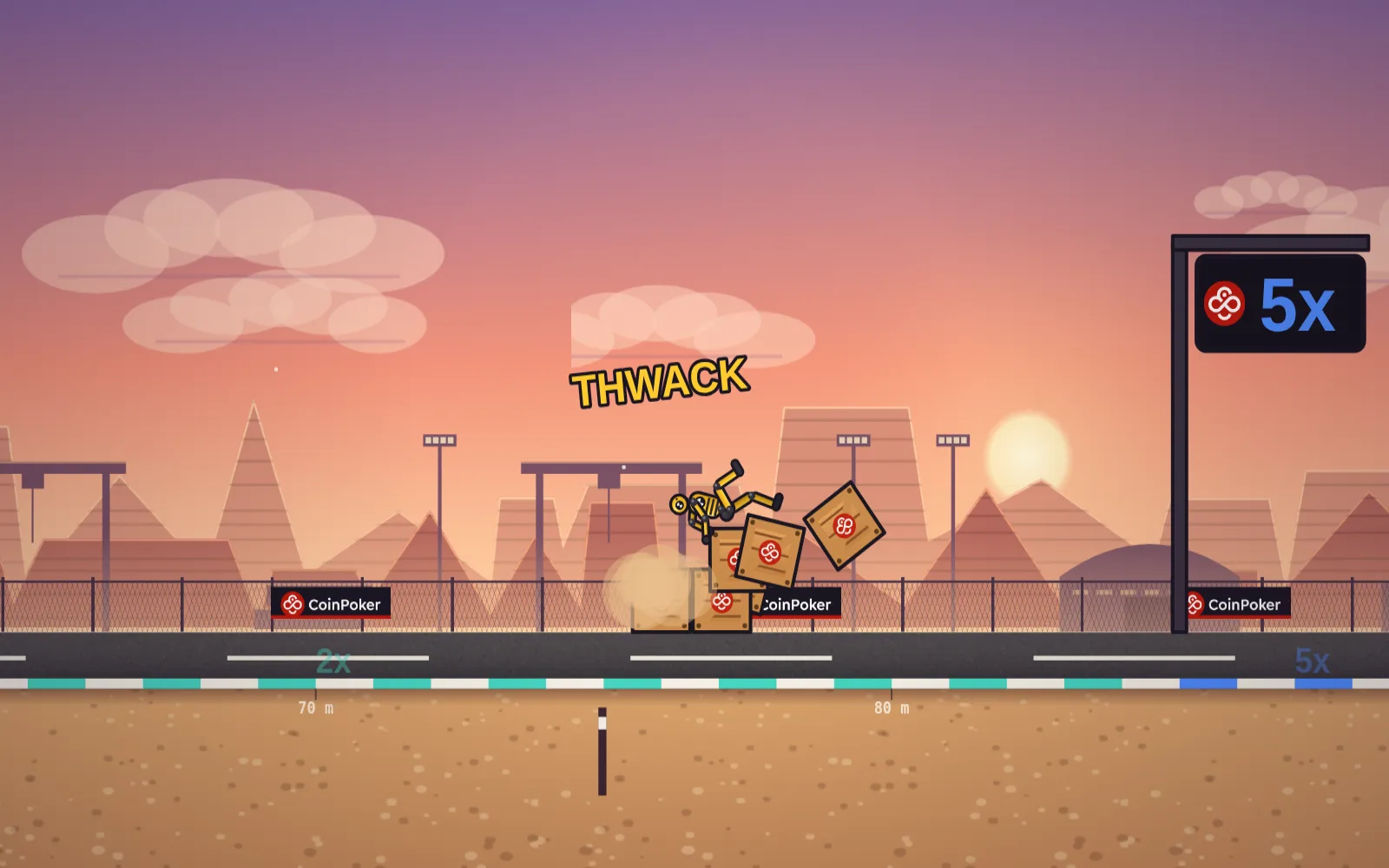
You press CRASH. A barrier shoots up out of the road, the car hits it at about 130 km/h and the crash test dummy goes straight through the windscreen. The further he flies, bounces and slides, the bigger the multiplier. Really big hits can knock an arm or a leg off.
There's no 0×. The barrier never stops him dead, so even the worst crash sends him a fair way down the track and pays something back, from 0.10× all the way up to 500×.
Same trick as Ricochet. The result is picked before you press anything, and the game finds a real physics route that ends in that zone, so pressing early or late makes no difference. I ran it 100 times and every round landed where it was meant to.
This is a very early concept. I built it quickly to find out if watching the dummy go is fun enough to do over and over. Pretty much everything you see is placeholder. The car, the dummy, the track and the sounds all need proper art and a lot of polish, and the maths isn't done.
- 500×The fan carries him onto the mega airbag, which fires him out past the big ramp. Very rare.
- 100×The mega airbag, or a long glide on the giant fan.
- 50×The giant fan blows him down the track into the second crate stack.
- 15–20×Off the launch ramp, or straight through the billboard.
- 5–10×Ploughs into the barrel pyramid or bounces off the airbag.
- 1–2×Clips the big road sign or smashes into the crate tower.
- 0.10–0.50×Through the cones or into the tyre wall. Some money back.
Early days. It needs a lot of work.
I think the idea has some legs. He's funny to watch. I was thinking of making him human and adding blood, but that might be a bit too macabre. It's very rough, so please judge the idea rather than the look.
- Proper art for the car and the dummy. Right now they're drawn in code as stand-ins.
- A much busier track. More set pieces, moving machinery and things to smash, plus the higher zones built out.
- Bigger crash moments. A proper windscreen smash, a crumpling bonnet, more dust and debris.
- Better camera work. Slow motion on the big hits, and tighter framing so he doesn't go tiny at the top of the big arcs.
- Real sound. The beeps and thuds in there are placeholders.
- The maths. The odds are rough placeholders, set to about 96% RTP. Nothing's been properly modelled yet.
- Longer rounds at the top. The 50× to 500× flights take 6 to 8 seconds. I want to get those quicker.
- Near misses. Sliding to a stop just short of the next zone only happens now and then. I want more of those.
- Phones. The layout works on a phone, but I haven't tested it on a real phone yet.
Human Cannonball.
Aim the cannon, fire the man, flatten the castle.
 Play it here
Drag to aim · Space or FIRE to play · D for debug
Play it here
Drag to aim · Space or FIRE to play · D for debug
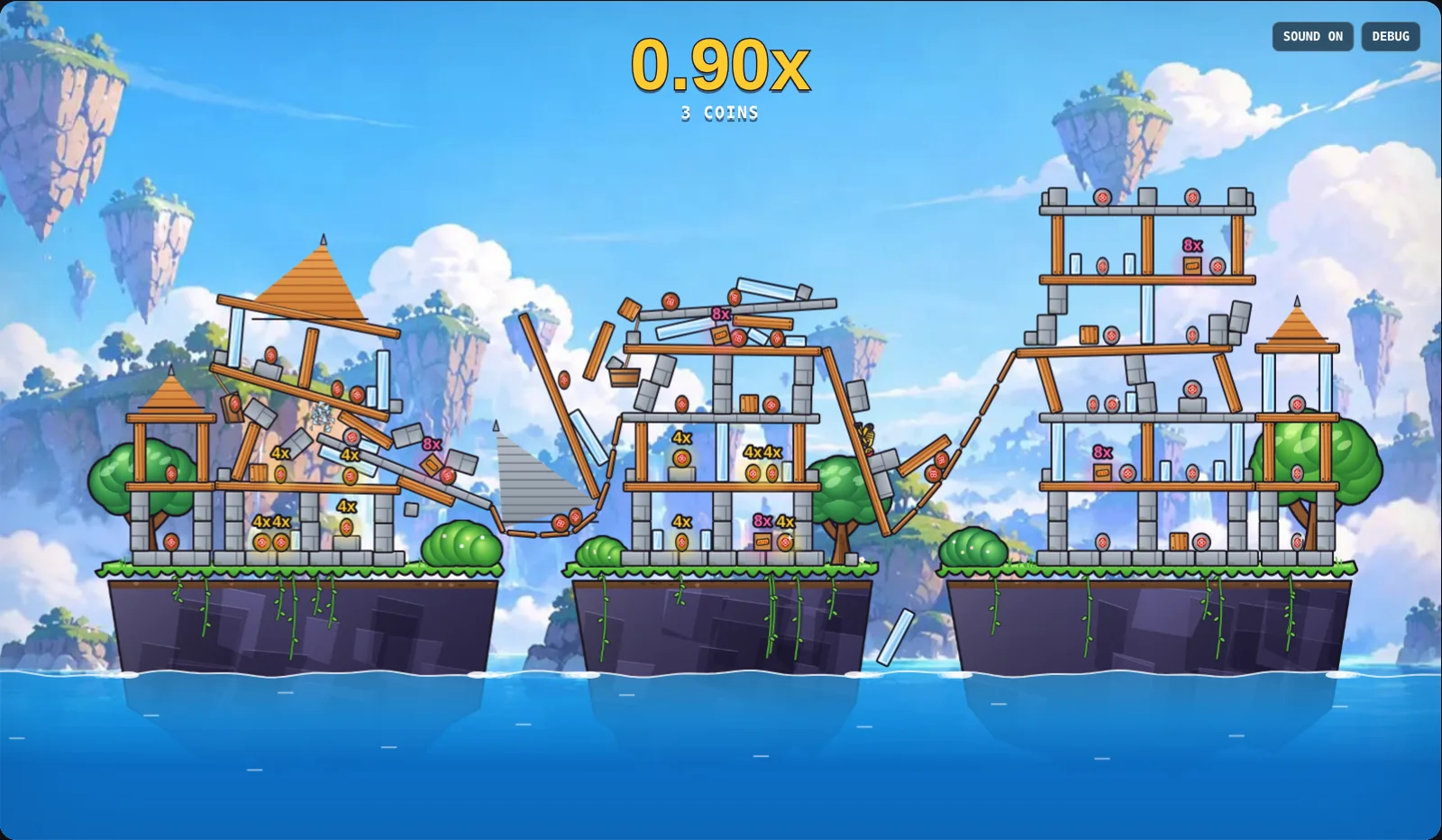
You set the cannon's angle and a dotted line shows where it's pointing. Press FIRE and the crash test dummy flies across the sea and slams into three tall linked towers made of stone, wood and ice, with rope bridges, hanging buckets and plank roofs. Everything after FIRE is the physics engine. Nothing steers him and nothing steers the collapse.
The towers hold 230 coins and 10 ticket crates. Any coin that gets hit hard pays, whether he hits it or a falling plank does, so every smash knocks something loose and the counter always ticks up. Most of those coins are worth very little, so most rounds still pay back less than the bet. The big ones are the gold coins and ticket crates tucked where they rarely get hit.
Under the hood it's the Blocks system. I simulated 150 shots in advance for every angle. When you fire, the game picks one for your angle (the bits you can't see are the exact powder charge and the spin), then the physics plays it out. Every angle pays 96.5%, so aiming changes the show, not the odds. Before each shot your device replays it to check it knocks loose the same coins.
This is an early concept. The background is the painted plate, but the towers, dummy, cannon and sounds are still first pass.
- TicketThe crates with a golden ticket. 1.5×, 5× or 20×.
- Gold16 coins that only come loose now and then. 0.8×, 2× or 6×.
- Silver65 coins that get hit fairly often. 0.1×, 0.08× or 0.04×.
- CopperThe other 149, the ones that fly everywhere. 0.02×, 0.015× or 0.01×.
Every shot pays something. Few pay back the bet.
As you can tell, this is very much based on Angry Birds, so it's rather a novelty. There's still a lot of work to do on the camera and tracking each shot.
He hits the towers on every shot and every shot knocks coins loose, so the win counter always moves. Back to the bet or better happens on 30% of shots on low, 19% on medium and 6% on high, with top wins of 14.4×, 34.8× and 117.5×. Every angle, 15° to 65°, lands on 96.5% exactly.
- Proper art for the towers. They're drawn in code. They need painting to match the background plate.
- A real character. The dummy and cannon are stand-ins.
- Bigger collapse moments. More dust and debris, splashes, and slow motion when a tower goes.
- Real sound. The booms, crashes and splashes are placeholders.
- Misses. With the birds gone he never misses. If we want the odd miss back, a gust of wind or a shorter charge would do it.
- Lots of tiny wins. Copper coins pay 0.01× to 0.02×. It feels busy, but players might read a 0.24× "win" as a loss.
- Rounds run long. About 7 seconds including the collapse. Could be trimmed.
- Phones and browsers. Tested in Chrome only. Safari and real phones still need checking.
Mines, iso glow.
Same Mines, drawn as a lit isometric blueprint.
 Play it here
Click a tile · arrows + space · C to cash out
Play it here
Click a tile · arrows + space · C to cash out
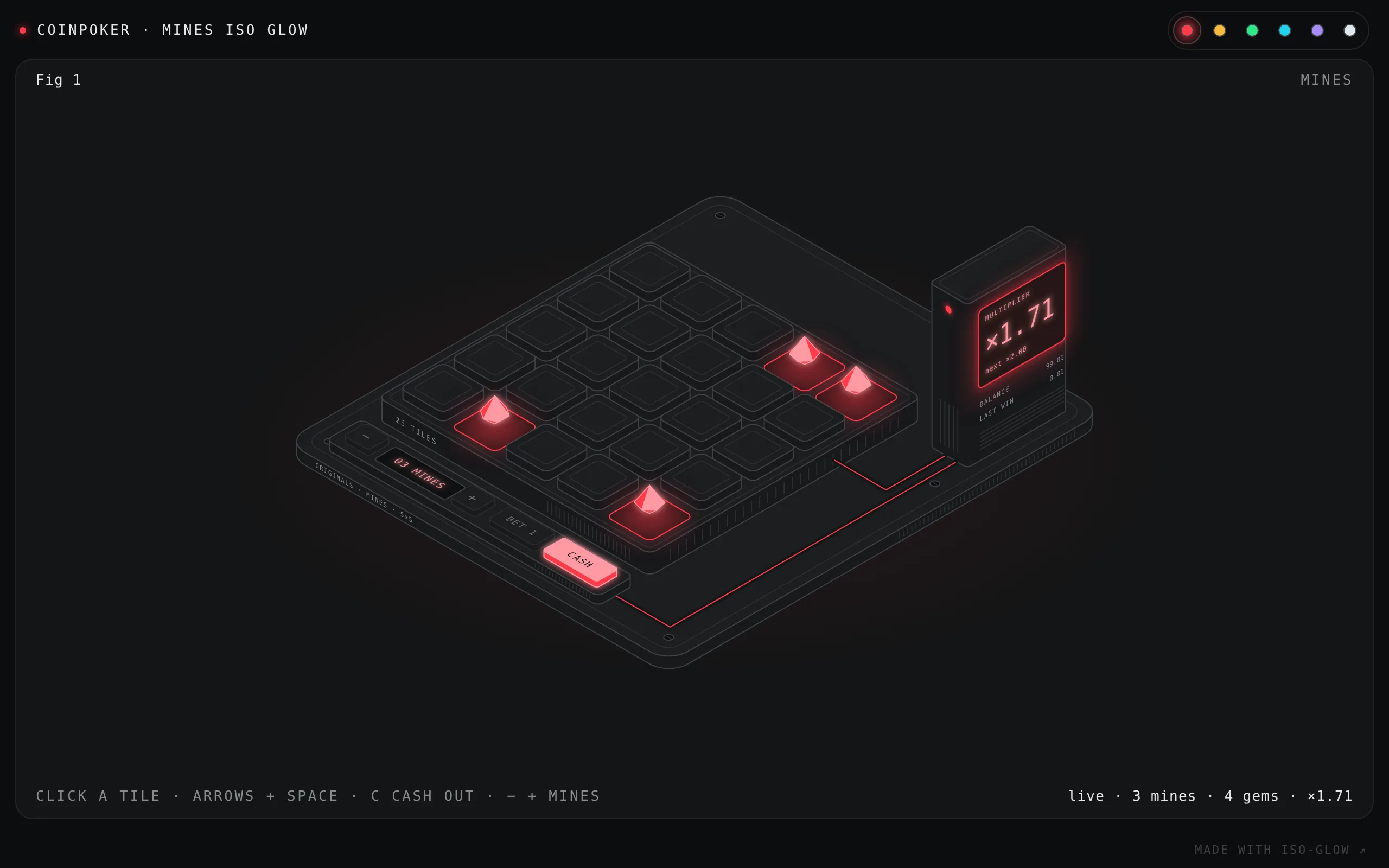
Not a new game, a new look. The whole thing is drawn as thin grey lines on a dark panel, and only what's live gets colour. A gem you've found glows. The cash button lights up once there's something to cash. The display tower glows while a round is running. Everything else stays dark, so your eye goes straight to what matters.
Click a tile and it lifts off to show a spinning gem or a mine. If no round is running, that first click places the bet too, so you're straight in. The tower tracks the multiplier and what the next gem would pay, and the console sets the mines and cashes out.
It's all drawn in code, one file, about 45KB. No images, no 3D engine. The colour picker in the corner reskins the lot.
- PickClick any tile. A gem lifts out and the multiplier climbs.
- Push onEvery gem pays more than the last. Three mines: 1.13× for one gem, 2× for four.
- CashTake the win any time after the first gem. The tower shows where the mines were.
- BustHit a mine and it turns white, the gems go dim, the tower reads BUST.
The look works. The question is where.
This is a test of a visual style rather than a game idea. It's calm, it's cheap to build and it reads clearly at any size, which makes it a contender for a whole family of Originals rather than just Mines.
- Real sound. The pings and thuds are synth stand-ins. The proper Mines samples can go straight in.
- A bet picker. The bet is fixed at 1 for the demo.
- A bigger bust. The mine hit is deliberately quiet. Could stand a bit more drama.
- Phones. The board is small in the phone frame. It needs its own phone layout.
- Brand fit. It's further from the CoinPoker look than the other games. Worth seeing if it can carry the felt or the chips.
Plinko, iso glow.
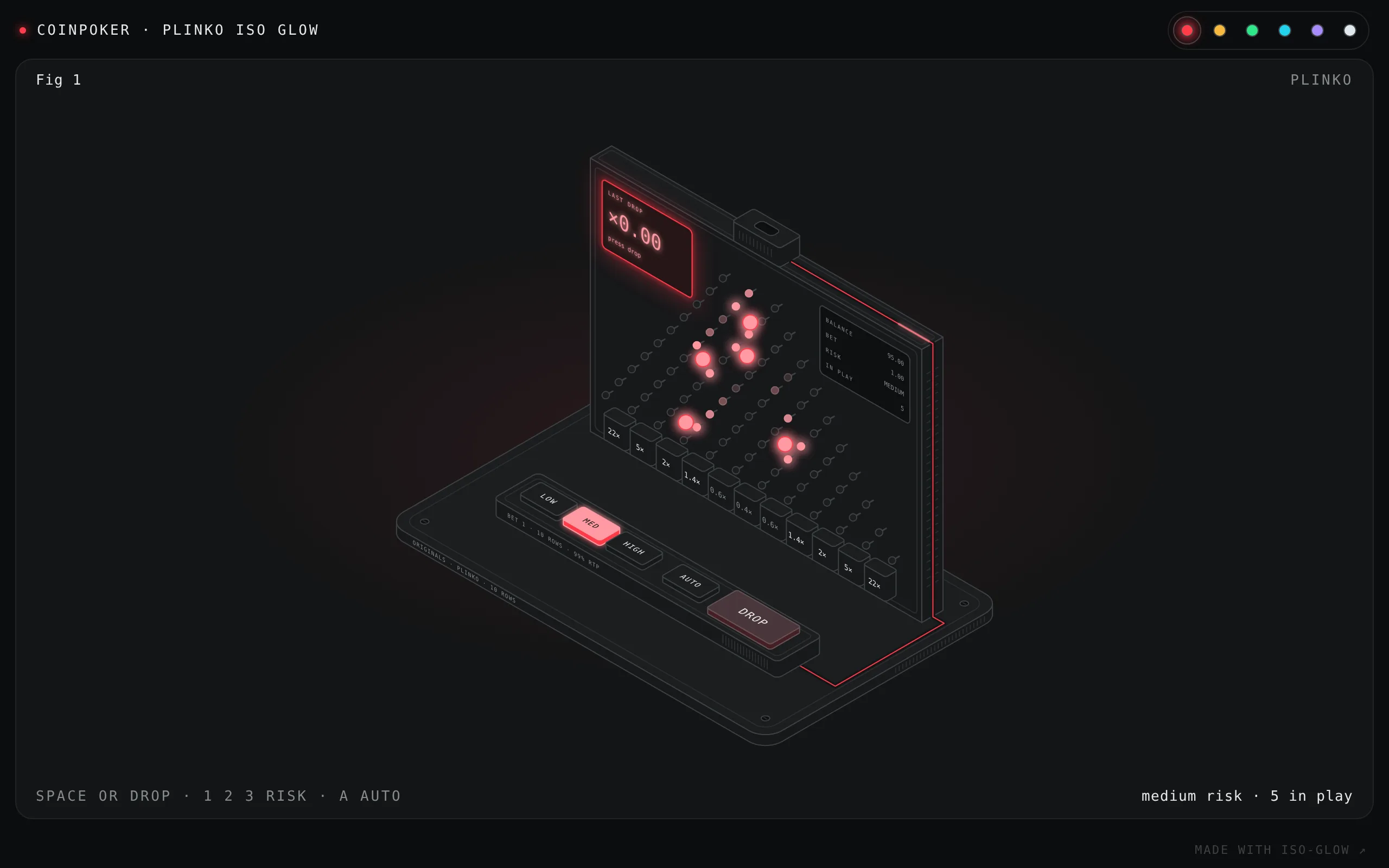
Ten rows of pegs that light up as the ball hits them.
 Play it here
Space or DROP · 1 2 3 risk · A auto
Play it here
Space or DROP · 1 2 3 risk · A auto
The game that suits this look best. The board stands upright, and every peg flashes as a ball hits it, with a tick that climbs in pitch as the ball gets lower. The slot it lands in sinks and glows, and stays lit until the next ball lands.
Every peg is a straight 50/50, so the path you watch is the actual result, not a show over a number picked in advance. Mash DROP and up to 12 balls can be in play at once.
The board's empty top corners, either side of the peg triangle, carry the screens: last drop on the left, balance and risk on the right.
- Low8.9× on the edges, never below 0.5×.
- Medium22× on the edges, 0.4× in the middle.
- High76× on the edges, 0.2× in the middle. Edge slots land about once in 512 drops.
Made for this look. Needs its own sound.
These are the standard 10-row Stake tables, all around 99%. The pegs, slots and screens all work. What's missing is polish.
- Real sound. The ticks and chimes are synth stand-ins.
- A bet picker and more rows. The bet is fixed at 1 and the board is 10 rows only.
- Phones. The board is small in the phone frame.
- Big wins. A 76× lands the same way as a 0.2×. It needs a moment.
Wheel, iso glow.
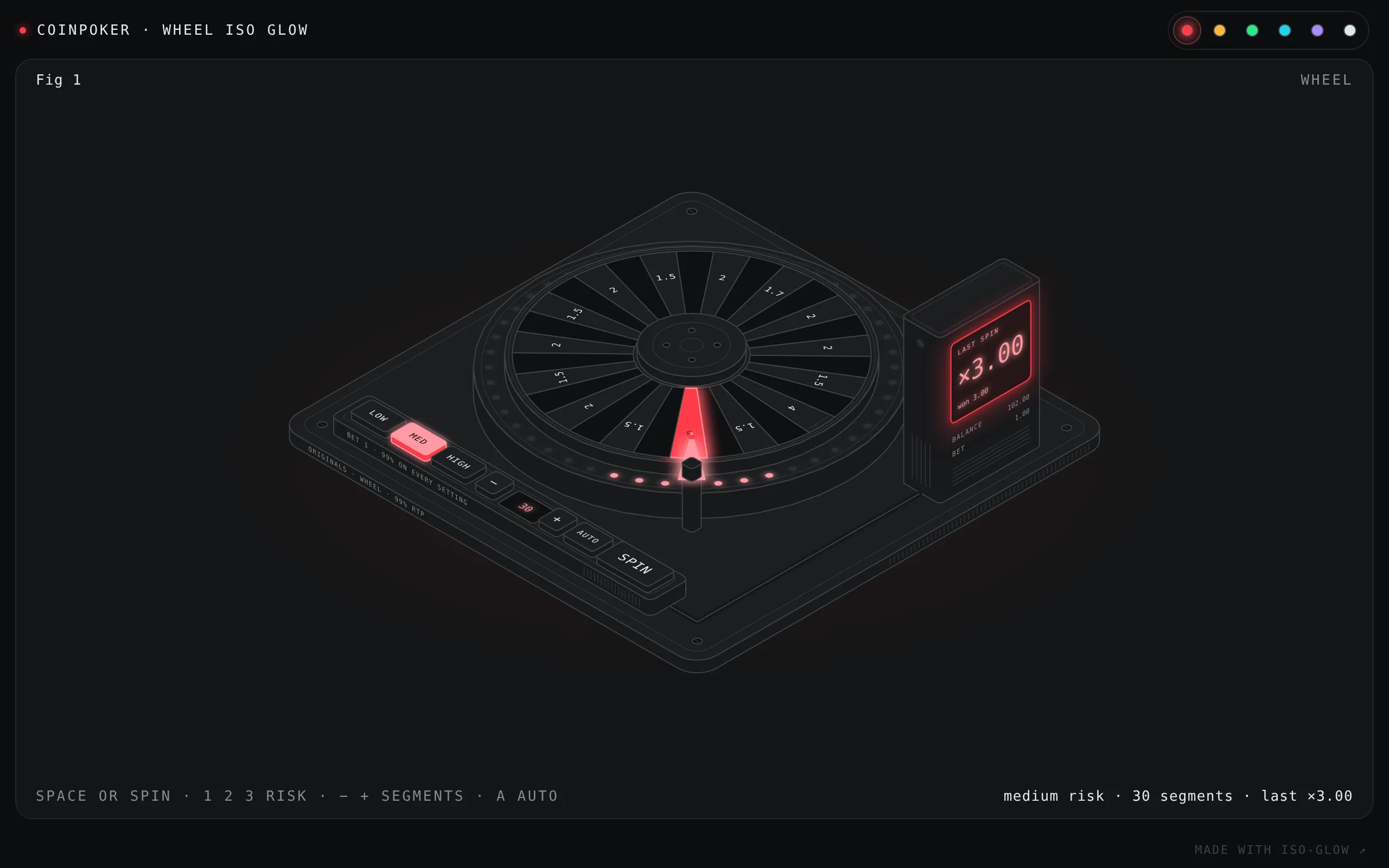
A flat wheel on a plinth. The winner lights up.
 Play it here
Space or SPIN · 1 2 3 risk · − + segments
Play it here
Space or SPIN · 1 2 3 risk · − + segments
The wheel lies flat and spins in place. Each segment flashes as it passes the pointer, with a click, so you get a red trail that slows down with the wheel. A ring of lights chases round the rim and the pointer flicks on every click.
When it stops, the winning segment and the pointer light up and the rim lights next to the pointer stay on. A losing spin just goes dark.
The maths is the same as the main Wheel: my own Stake-shaped tables, Low, Medium and High risk, 10 to 50 segments.
- LowMostly 1.2× and 1.5×, with a few blanks.
- MediumHalf the wheel pays, from 1.5× up to 5×.
- HighOne segment pays everything. 49.5× on a 50-segment wheel.
Simple and easy to read. Maybe too simple.
It reads instantly, even at 50 segments. Whether it's got enough going on next to the main Wheel is the open question.
- Real sound. The clicks and chimes are synth stand-ins.
- A bet picker. The bet is fixed at 1 for the demo.
- Small labels. At 50 segments the numbers get tiny.
- Phones. Needs its own phone layout.
More coming.
Next concepts land here as they're built.